IN THE NAME AND BY AUTHORITY OF
THE STATE OF TEXAS:
I, Randall Kelton, hereinafter referred to as "Complaint," under penalty of perjury, do state that I have personal knowledge I have good reason to believe and do believe based upon the following information:
One month after Complainant filed the above referenced documents with Evans, on the 27th day of April 2009, Evans prepared a criminal complaint against Complainant accusing Complainant of “operating a private investigating business without a license.” The complaint contained a bald statement accusing Complainant of “operating a private investigating business without a license,” but did not reference any particular statute; neither did the complaint state any facts supporting the allegation of an offense. On checking the court record, there is no evidence that an affidavit of fact was filed with the court by Evans in support of the complaint.
A warrant must not issue until after the judicial officer has been supplied with sufficient information to support an independent judgment that probable cause exists for the warrant. Thus, the affidavit on which the warrant is based must provide a sufficient basis upon which a neutral and detached magistrate can make a finding of probable cause [ Whiteley v. Warden of Wyoming Penitentiary, 401 U.S. 560, 564-565, 91 S. Ct. 1031, 28 L. Ed. 2d 306 (1971)
An affidavit that merely recites the elements of the crime charged, contains no affirmative allegations that the affiant spoke with personal knowledge of the matters contained in the affidavit, and fails to indicate any source for the affiant's conclusions is insufficient and cannot support the issuance of a warrant [see Giordenello v. United States, 357 U.S. 480, 484-486, 78 S. Ct. 1245, 2 L. Ed. 2d 1503 (1958) ; Ware v. State, 724 S.W.2d 38, 41 (Tex. Crim. App. 1986) conclusory affidavit insufficient].
In as much as Evans is a career police officer and past county sheriff, it cannot be construed that he was somehow ignorant of the law concerning the filing of criminal complaints.
It is said, however, that this construction of the Act will not save it from the infirmity of vagueness since neither a law enforcement official nor a trial judge can know with sufficient definiteness the range of rights that are constitutional. But that criticism is wide of the mark. For the specific intent required by the Act is an intent to deprive a person of a right which has been made specific either by the express terms of the Constitution or laws of the United States or by decisions interpreting them. Take the case of a local officer who persists in enforcing a type of ordinance which the Court has held invalid as violative of the guarantees of free speech or freedom of worship. Or a local official continues to select juries in a manner which flies in the teeth of decisions of the Court. If those acts are done willfully, how can the officer possibly claim that he had no fair warning that his acts were prohibited by the statute? He violates the statute not merely because he has a bad purpose but because he acts in defiance of announced rules of law. He who defies a [*105] decision interpreting the Constitution knows precisely what he is doing. If sane, he hardly may be heard to say that he knew not what he did. 9SCREWS ET AL. v. UNITEDSTATES, 325 U.S. 91, 105)
According to the testimony of Evans, Evans did not deliver the above referenced complaints to the grand jury, but instead gave them to Elmer Beckworth.
Sec. 37.10. TAMPERING WITH GOVERNMENTAL RECORD.
(a) A person commits an offense if he:
(1) knowingly makes a false entry in, or false alteration of, a governmental record;
(2) makes, presents, or uses any record, document, or thing with knowledge of its falsity and with intent that it be taken as a genuine governmental record;
Complainant, on cross-examining Evans asked Evans to tell the court what the elements of the alleged crime were, to which Evens testified that he did not know. Complainant then asked Evans what would constitute a violation, to which Evens testified that he had no idea. Evans testified that he filed the complaint because prosecutor Caldwell told Evans that the filing by Complainant was a crime.
Sec. 37.11. IMPERSONATING PUBLIC SERVANT. (a) A person commits an offense if he:
(1) impersonates a public servant with intent to induce another to submit to his pretended official authority or to rely on his pretended official acts; or
(2) knowingly purports to exercise any function of a public servant or of a public office, including that of a judge and court, and the position or office through which he purports to exercise a function of a public servant or public office has no lawful existence under the constitution or laws of this state or of the United States.
(b) An offense under this section is a felony of the third degree. (emphasis added)
Evans, by his testimony, did not deliver the documents which were put in his custody to the grand jury. The document were surrendered to Evens under the stipulation that he would deliver them to the foreman of the grand jury. Evans, acting as bailiff for the grand jury apparently took it upon himself to determine what was good for the grand jury to see and what was not good for them to see. Complainant can find no law, rule, regulation, or starie decisis that would extend the security service of a bailiff to making determinations as to what the grand jury should see and what they should not see. (see Criminal Affidavit SectionQ attached)
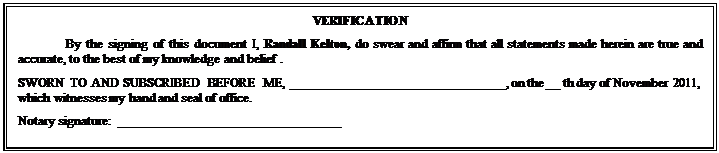
Notary Stamp
Therefore, I charge that heretofore, and
before the making and filing of this complaint, on or before the 26th
day of November 2011, in Cherokee County and State of Texas, Joe
Evans, did then and there unlawfully and willfully tamper with a
government document, in an act of Tampering With A Government Document as
defined by Section 37.10 Texas Penal Code.
_________________
Randall Kelton
PO Box 1
Boyd, Tx 76023
 512 430 4140